Feet are often the first thing to go numb on a winter swim, and Irish swim spots are hard on them: barnacled steps, stony beaches and slippy slipways. A pair of neoprene swimming socks fixes both problems for not much money, which is why they're usually the first bit of kit a sea swimmer buys after a cap.
This guide covers how they work, what thickness to get, socks or boots, how they should fit, and the pairs you can buy in Irish shops, with prices we checked on 14 November 2026. For the rest of your winter kit, see our winter sea swimming kit guide.
How swimming socks work
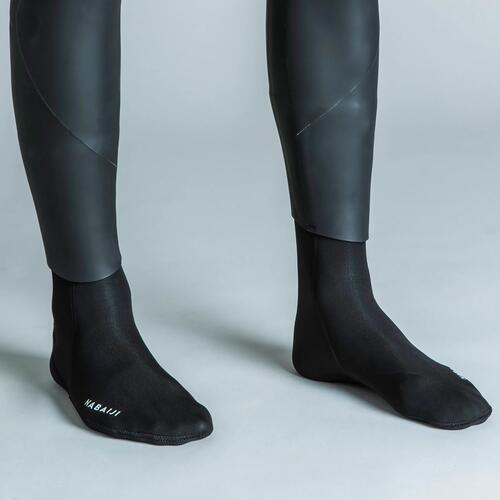
Neoprene is a rubber foam full of tiny air bubbles. A snug sock lets in a thin layer of water, your feet warm it up, and the neoprene slows that heat from escaping. That's why fit matters so much: a loose sock keeps flushing the warm water out and letting cold water in.
They make cold water more comfortable. They don't make it safe to stay in longer than you would without them, so keep your dips short in winter and get out when your body tells you to.
What thickness do you need?
- 2 mm: autumn and spring, or for swimmers who want more feel in the water. Lighter and easier to swim in.
- 3 mm: the most common choice for winter dips in Ireland.
- 3.5 to 4 mm: the warmest socks, for January and February and for anyone whose feet really suffer in the cold.
- 5 mm and up: these are surf boots rather than swim socks. Very warm, but heavy to swim in.
Socks or boots?
Socks are thin and flexible with a light sole, or no sole at all, so they're easy to swim in. Boots have a thicker, tougher rubber sole and often a zip or ankle seal, so they're better for walking over stones, rocks and shingle, but they feel clumsier in the water.
If you mostly get in off a beach or a slipway and swim, socks are fine. If you walk across rocks to get in, or swim somewhere with sharp stones underfoot, go for a boot such as O'Neill's 2 mm Reactor reef boot (€32) or Zone3's 4 mm Heat Tech Dura swim boot (€60), both at Surfdock.
Swimming socks in Irish shops
| Socks | Thickness | Sole | Price |
|---|---|---|---|
| TWF Mausered (Borderland, Muff) | 3 mm | Not stated | €9.99 |
| Nabaiji neoprene (Decathlon) | Not stated | Grip sole | €21 |
| Gill neoprene (Surfdock) | Not stated | Seam-free sole panel | €21, was €28 |
| Typhoon Storm3 (Surfdock) | 3 mm | Toe and heel grip | €23 |
| O'Neill Heat (Surfdock) | 3 mm | No sole or tread | €30 |
| Jobe (Surfdock) | 3 mm | Not stated | €32 |
| Orca (Surfdock) | 2 mm | Silicone grip | €45 |
| Huub (Amphibian King) | 3 mm | Reinforced, split toe | €45 |
| Zone3 Heat Tech (Surfdock) | 3.5 mm | 3D grip | €49 |
| Zone3 Yulex (Surfdock) | 3.5 mm | Abrasion-resistant | €49 |
Sizes sell out fast in winter. When we checked, the Typhoon socks were down to one size at Surfdock and the Gill socks to Large only, so check before you set your heart on a pair.
- TWF Mausered 3 mm (€9.99). From Borderland, a surf shop in Muff, Co. Donegal. Titanium-lined neoprene with flat-taped seams, in sizes from kids' to UK 11. By far the cheapest pair we found.
- O'Neill Heat 3 mm (€30). A simple slip-on sock with flatlock seams. It has no sole or tread: O'Neill makes it to wear inside boots or fins, so take care on wet slipways.
- Orca 2 mm (€45). Higher at the ankle, with a silicone grip on the sole for slippy steps. A good choice for spring and autumn.
- Huub 3 mm (€45). From Amphibian King. A split toe stops it twisting on your foot, and it has a reinforced non-slip sole and Velcro straps, so it's closer to a light boot.
- Zone3 Heat Tech 3.5 mm (€49). Titanium-lined, longer in the leg, with a Velcro strap and a grippy sole. The warmest socks here.
- Zone3 Yulex 3.5 mm (€49). Made from Yulex natural rubber instead of standard neoprene, with a recycled lining and a tough sole.
Our picks
- Best budget: TWF Mausered 3 mm (€9.99, Borderland). A 3 mm titanium-lined sock for under a tenner.
- Warmest: Zone3 Heat Tech 3.5 mm (€49, Surfdock). Thick, long and sealed with a Velcro strap, for the coldest months.
- Best grip: Orca 2 mm (€45, Surfdock). A silicone sole for slipways and ladders.
- Most like a boot: Huub 3 mm (€45, Amphibian King). Split toe, reinforced sole and straps.
- Best for inside boots: O'Neill Heat 3 mm (€30, Surfdock). No sole, so it slides into boots or fins as an extra layer.
How they should fit
- Snug, not tight. No baggy bits at the toes or heel, but you should still be able to wiggle your toes.
- Go by the shop's size chart. Most are sized by UK shoe size, often in pairs of sizes. If you're between two, the smaller one usually stays warmer, as long as it doesn't pinch.
- Longer is warmer. Socks that come higher up the ankle, or close with a strap, let less water in.
- Over or under the wetsuit? If you wear a wetsuit, socks with a strap can go over or under the leg. Under keeps more water out.
Looking after them
Rinse them in fresh water after every swim, turn them inside out to dry, and keep them out of strong sun and off radiators, which break neoprene down. Don't put them in a tumble dryer. A pair looked after like this will last several winters.
Warm up afterwards
Cold feet are the slowest part of you to warm up. Pack dry socks and warm shoes, get changed quickly, and have a hot drink. Better still, finish at a sea sauna: we list saunas all around the coast, and our sea swimming safety guide covers swimming in cold water safely.