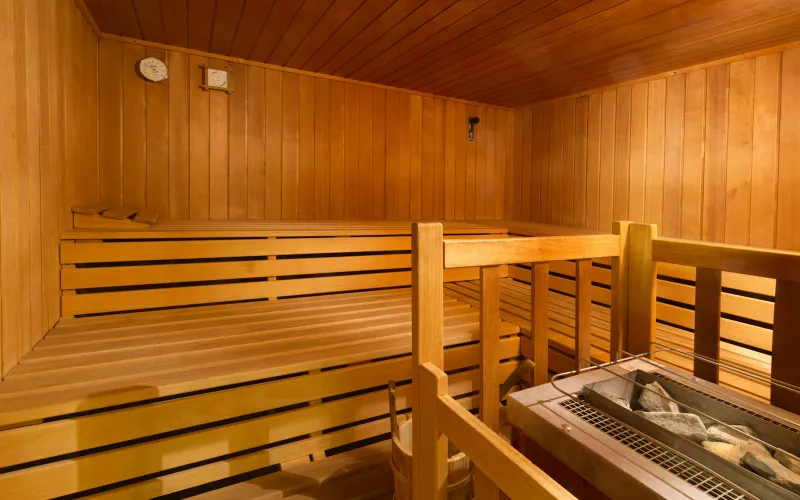
If you've only ever used the leisure centre, you've probably sat in both: the wood-lined room with the stove, and the tiled room you can barely see across. They're both ways of getting very warm, but they work differently and feel very different. Here's how they compare, and how to choose.
The short version
| Sauna | Steam room | |
|---|---|---|
| Heat | Dry heat from a stove and hot stones | Wet heat from a steam generator |
| Typical temperature | Around 66 to 91°C | Around 43 to 48°C |
| Humidity | About 5 to 10%, rising briefly when water goes on the stones | 95 to 100% |
| Room | Wood-lined, with benches | Tiled or glass, sealed to hold the steam |
| Where in Ireland | Outdoor and sea saunas, spas, gyms | Mostly hotel spas, gyms and leisure centres |
How a sauna works
A sauna heats the air with a wood-fired or electric stove topped with stones. The air is dry most of the time, which is why you can sit in temperatures that would be unbearable in water. Pour a ladle of water on the stones and you get a burst of steam, called löyly, that makes the room feel much hotter for a minute or so before the air dries out again. Our first sauna guide explains how that works in a shared session.
How a steam room works
A steam room is filled by a generator that boils water and pumps the steam in. The room is lined with tile, glass or plastic and sealed so the moisture stays put, which keeps the humidity close to 100%. The temperature is much lower than a sauna's, but it doesn't feel it.
Why the steam room feels so hot
Your body cools itself by sweating, and the sweat cools you as it evaporates. In a dry sauna it evaporates quickly. In a steam room the air is already saturated, so the sweat just runs off you and doesn't cool you down. That's why 45°C of wet heat can feel as intense as a much hotter sauna.
Which is better?
It mostly comes down to what you enjoy. The evidence doesn't crown either one:
- Most research is on dry saunas. The studies people quote about saunas and heart health or longevity are almost all Finnish-style dry saunas. Steam rooms have been studied far less. Our guide to sauna benefits covers what that research does and doesn't show.
- Blocked nose or chesty? Many people find warm, wet air soothing, and a steam room may give temporary relief. That's not the same as treating anything, and steam hasn't been proven to clear congestion.
- You like it hot but find the heat hard to breathe? A dry sauna with a quieter hand on the ladle may suit you better.
- You love the ritual: the wood, the stove, the cold dip after. That's a sauna thing.
Can you use both, and which goes first?
There's no fixed rule. Since they give you a similar kind of heat, it's fine to stick to one. If you do use both, treat each as its own hot round: cool down and rest in between, and drink some water. Our sauna and ice bath routine covers the hot, cold and rest pattern. Don't stack long sessions in both back to back.

Safety
- Keep it short. Healthline notes that more than 15 minutes in a steam room can dehydrate you. Drink water before and after.
- Skip both if you're pregnant, unwell with a fever, recovering from surgery or immunocompromised, unless a doctor has said it's fine.
- Check with your GP first if you have a heart condition or low or uncontrolled blood pressure.
- Sit on a towel and wear sliders. Steam isn't hot enough to kill all bacteria, and warm, wet rooms suit them.
- Get out if you feel dizzy, sick or short of breath.
Where to find each in Ireland
Every place on this site is a sauna: wood-fired and electric saunas by the sea, on lakes, in gardens and in town. Many also have a cold plunge or a sea dip on the doorstep. Steam rooms are mostly indoors, in hotel spas, gyms and leisure centres. Browse saunas by county, see the map, or find a sauna with a cold plunge or ice bath near you.